01 / History
Before the footnote
A continent with its own record of itself.
Origins
Out of the rivers
The Arawakan languages are among the most widely spread language families in the Americas. Their speakers moved out of the great river systems of northern South America — the Orinoco and the Amazon and their tributaries — and over centuries carried farming, pottery, canoe-building and trade north through the islands of the Caribbean and west across the lowlands.
By the time European ships arrived, Arawak-speaking peoples had been living, building and trading across that range for thousands of years. Lokono communities held the mainland coasts of what are now Guyana, Suriname, French Guiana and Venezuela. Taíno societies filled the Greater Antilles with towns, plazas, ballcourts and chiefdoms led by caciques.
Contact
1492 was not year zero
The people Columbus met were not a blank page. They had governments, agriculture, medicine, astronomy, sport, sculpture and law. What followed — enslavement, forced labour, epidemic disease and the seizure of land — was catastrophic, and it is usually where the textbook stops.
The textbook is wrong. Arawak peoples did not vanish. They fought, negotiated, withdrew inland, intermarried, adapted and endured. Lokono communities exist today. Taíno descent is carried in the Greater Antilles in blood, in place names, in food, in language and in people who name themselves.
Continuity
The living archive
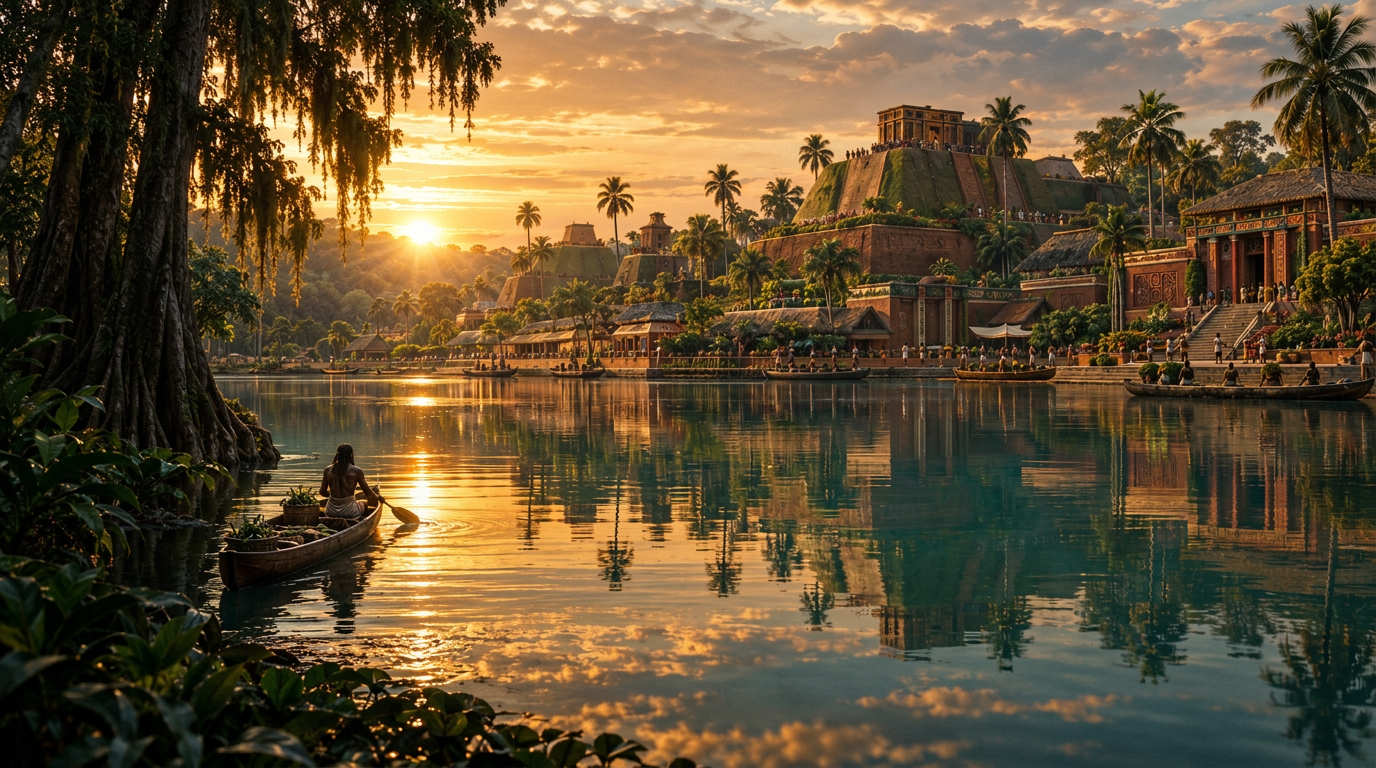
This work treats that continuity as the main story rather than an epilogue. Southern Arawak reconstructs cities, clothing, movement, ceremony and daily life with the same seriousness usually reserved for Rome or Egypt — because the standard of care should not change with the continent.
Every film, portrait and reconstruction here begins from one premise: history was never colorless, and the Americas were never empty.